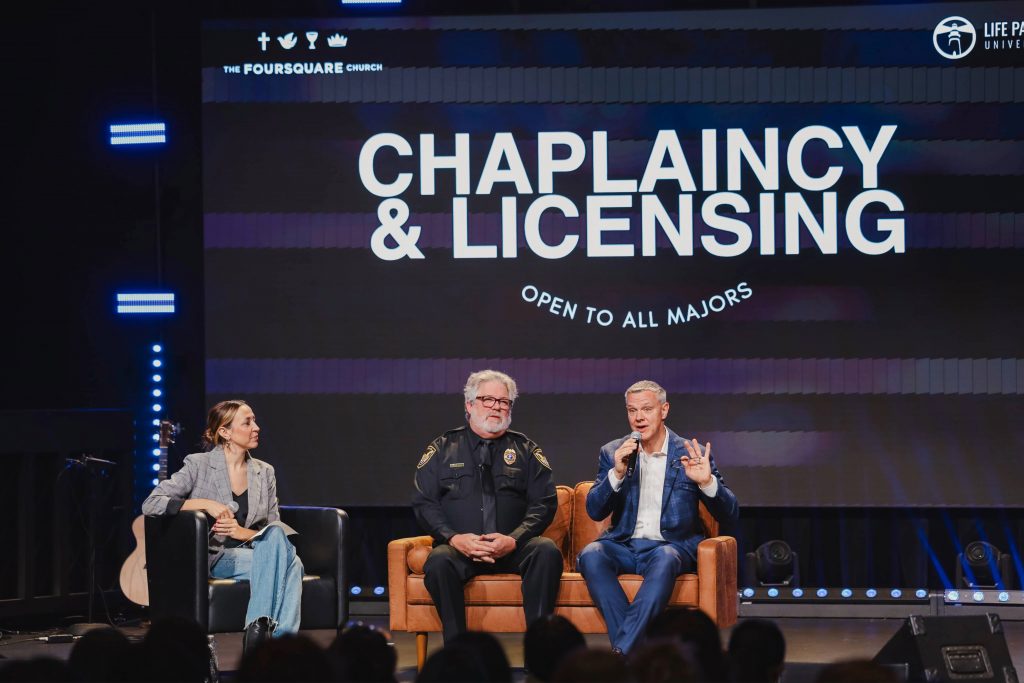
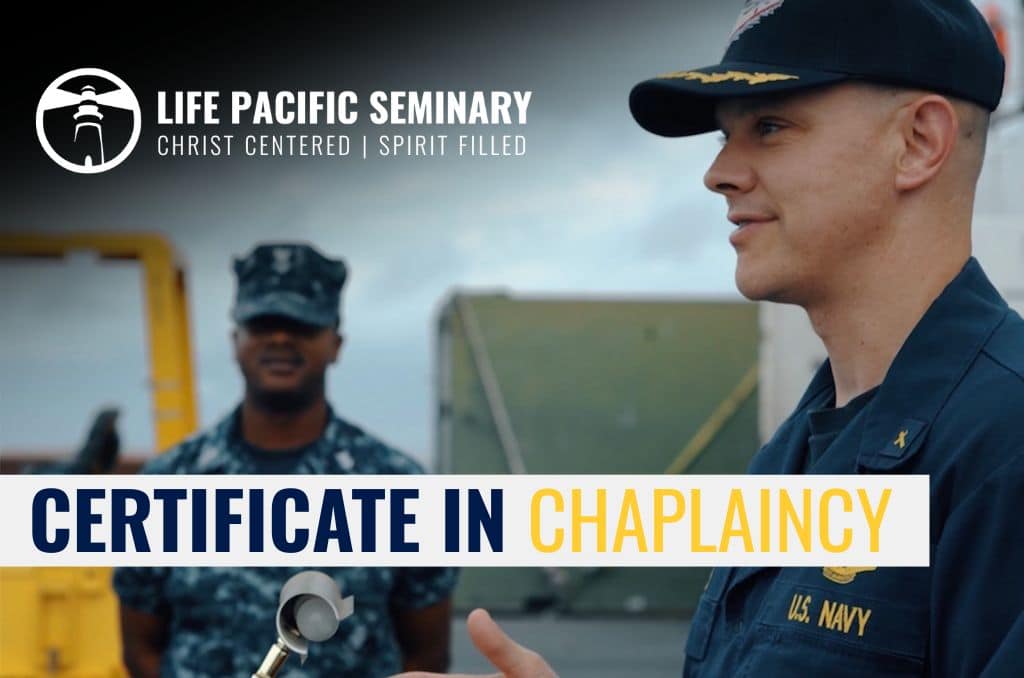
Earlier this year, Life Pacific University introduced a Certificate in Chaplaincy designed to help students and ministry leaders serve beyond the traditional church setting. The fully online program costs $340, can be completed at the student’s own pace, and offers a direct pathway to licensing and endorsement through Foursquare Chaplains International.
For many aspiring chaplains, the road to ministry has been marked by delays and requirements that made it difficult to begin serving. The certificate aims to change that by providing accessible, affordable preparation for work in hospitals, prisons, military bases, and other community spaces.
“When I got licensed 15 years ago, I wish something like this existed then because the barriers that I felt like I had to go through in order to go help people seemed overwhelming at the time,” said Chaplain Chris Foreman.
What Is a Chaplain?
Chaplains serve as pastors or missionaries in the public square, meeting people where they are instead of asking them to come inside church walls. They offer spiritual care and emotional support to people in crisis or transition, often in institutions such as hospitals, schools, prisons, or the military.
They are sometimes the first to arrive at an accident scene or the last to leave a hospital room. Their work, both practical and pastoral, is often summed up by the phrase: “We nurture the living, we care for the wounded, and we honor the fallen.”
Meeting People Where They Are
Chaplains provide spiritual care in the everyday settings where people experience crisis, loss, or transition. They minister in hospitals, schools, police departments, hospices, and correctional facilities – often at moments when people are most in need of comfort and guidance.
“I’ve had such amazing experiences ministering to people from all walks of life with mental health challenges, suicidal patients, patients working through gender identity issues,” said Dr. Ray Houk. “It is just an amazing opportunity to minister people who are from all walks of life.”
Foreman described his own approach to chaplaincy.
“I’m actually going to stop what I’m doing and I’m gonna come to you,” he said. “I didn’t see myself as someone who would need to promote something that I believed in, but rather I’m going to demonstrate, I’m going to show up, I’m going to be there in your life, right there when it’s the worst, when it’s the toughest, when it’s the hardest.”
Two Types of Chaplaincy
The Certificate in Chaplaincy prepares students for both civilian and military ministry.
Civilian Chaplaincy
Graduates can serve in hospitals, hospices, schools, nonprofits, and correctional facilities, offering care and presence in times of crisis. Many civilian chaplains find employment through hospitals, government agencies, and nonprofit organizations. Salaries for government-employed chaplains, such as those in the Department of Veterans Affairs or the Bureau of Prisons, typically start around $80,000 a year.
Military Chaplaincy
Students interested in the military can apply for the Chaplain Candidate Program with tuition assistance from the Army, Navy, or Air Force. Candidates drill 30 to 45 days during academic breaks while completing a Master of Divinity, then transition to active duty, reserves, or National Guard ministry. Base pay for a starting military chaplain is about $60,000 a year, plus another $50,000 in tax-free housing allowance.
Don Eubank, Foursquare Church military chaplain endorser since 2014, explained the difference between pastoral ministry and chaplaincy.
“When I was a pastor of a Foursquare Church, the most important hour or time of every week was Sunday morning at 10:00 AM when I was in the pulpit,” he said. “In the Army chaplaincy where I served for 28 years, the most important moments were the hours between Monday and Saturday, because I worked and lived with my congregation. When I showed up at the motor pool, in the field, at the range, on deployments, I was welcomed by the sergeants and the platoon leaders and the company commanders.”
Training and Mentorship
The four-course program includes Introduction to Chaplaincy, Ethics and Legal Matters, Crisis Intervention Skills, and Spiritual and Mental Health. Students are paired with experienced mentors through Foursquare Chaplains International, which has more than 350 active chaplains serving in the United States and abroad.
“You’re part of a community,” Houk said. “You have a sense of belonging and camaraderie with 350 other Foursquare chaplains working in schools, hospitals, hospice settings, Bureau of Prisons, and military installations.”
Stories From the Field
Eubank shared a story from his deployment to Iraq.
“The Lord had given me a word for the commander. I was terrified to give this word. The message was ‘yes’ to your prayer request,” he said. “Colonel Harmon looked at me and there were tears coming down his face. He said, ‘Chaplain, I’m gonna tell you what my prayer is. I wanna take all my soldiers home.’ We redeployed, Colonel Harmon took all of his soldiers home. We did not lose a single soldier. That was a God moment.”
Foreman described receiving a FaceTime call from a soldier he had never met.
“He says, ‘Hey Chaplain, I heard you’re the person I’m supposed to speak to. I’m thinking about taking my life.’ He had a weapon in his hand,” Foreman said. “I found myself asking the Lord for guidance and wisdom. To fast forward to this past weekend, that soldier celebrated his 28th birthday. He’s got a family and kids. He said, ‘Thank you, Chaplain, for picking up the phone. I don’t know what I was going to do.’”
Heather Riley, an MASL graduate who works in palliative hospice care, shared another account.
“There was a code blue. This gentleman went for over 7 minutes with no oxygen to his brain. Every physician and nurse was certain this person was brain dead,” she said. “The family asked me to intercede with them, to believe with them, to pray with them. About 4 months later, I got a phone call. It was this gentleman, and it was his voice saying, ‘Chaplain, I heard you praying. I heard you every moment. The other clinicians would come in and profess death, and you would come in and proclaim life. Thank you for proclaiming life over me.’”
A Clear Path to Serve
University leaders say the Certificate in Chaplaincy provides a simple and affordable path for those called to ministry outside the traditional church.
The program removes degree barriers, allows new students to enroll the first Monday of every month, and can be completed at each student’s pace. Applications are due five business days before the next enrollment date.
“Life Pacific is…removing a lot of those barriers so you don’t have to question your calling,” Foreman said. “If you feel called it’s time to go. And this is the time to sign up to do whatever you gotta do because they’re saying ‘We need people in the marketplace. We need people in the military.’”
More Information
The Certificate in Chaplaincy at Life Pacific University costs $340 and is offered fully online. Students gain credentials for endorsement through Foursquare Chaplains International and may pursue civilian or military chaplaincy.
📞 Call or Text: (877) 886-5433
📧 Email: admissions@lifepacific.edu
🌐 Website: lifepacific.edu/certificates/certificate-in-chaplaincy
🔗 Military Chaplaincy: foursquare.org/chaplains