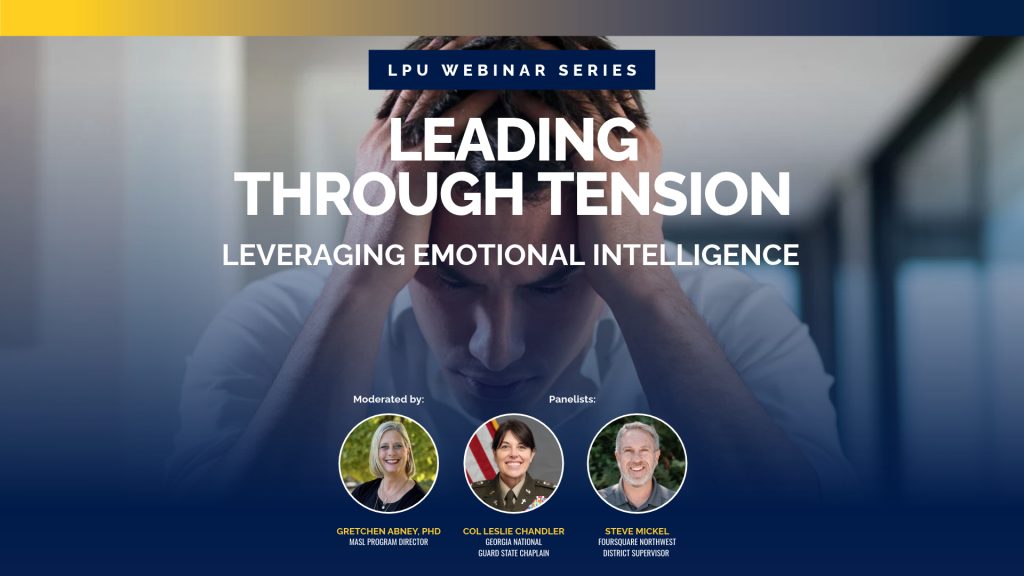
Military and ministry leaders share practical insights on managing conflict, navigating difficult conversations, and leading with greater self-awareness.
Leadership inevitably involves tension, but how leaders respond to that tension can make all the difference.
Life Pacific University’s Strategic Leadership program recently hosted Leading Through Tension: Leveraging Emotional Intelligence, a webinar exploring how emotional awareness can strengthen relationships, improve communication, and help leaders navigate challenging situations.
Hosted by Dr. Gretchen Abney, Director of LPU’s Master of Arts in Strategic Leadership program, the discussion featured Colonel Leslie Chandler, State Chaplain for the Georgia National Guard, and Dr. Steve Mickel, Northwest District Supervisor for The Foursquare Church.
“As leaders, we get to shape the emotional climate of our teams and organizations,” Abney shared. Drawing from her doctoral research on anxiety and leadership, she explained that our emotional responses influence not only our decisions but also the trust, relationships, and overall health of the people we lead.
Learning to Lead Through Tension
Chandler drew from her military career, including two deployments to Afghanistan, to illustrate the importance of emotional intelligence in high-pressure situations.
She recalled an early deployment when she was asked to help determine whether a soldier experiencing significant emotional struggles should remain overseas or return home. The experience reinforced how important self-awareness is when decisions carry serious consequences for others.
“Don’t let your emotions take you somewhere your brain can’t bring you back from,” Chandler shared, describing advice she regularly gives soldiers.
Mickel spoke candidly about his own experiences with conflict, acknowledging that his natural tendency has been to withdraw from difficult conversations. Over time, he recognized that stepping away could sometimes create even more tension.
“What I found is that … that’s the place where real healing and growth in the relationship and the conversation can happen,” he shared about choosing to remain engaged rather than withdrawing.
One of Mickel’s most practical recommendations was simple: “Get curious before you get certain.”
He encouraged leaders to ask questions, seek clarification, and resist making assumptions about others’ intentions. Taking time to understand another person’s perspective can also create the space needed to manage one’s own emotional response.
Practical Tools for Healthier Leadership
Throughout the webinar, the panelists shared strategies leaders can put into practice immediately, including recognizing emotional triggers, pausing before responding, seeking honest feedback, and preparing thoughtfully for difficult conversations.
Chandler emphasized the importance of rest, particularly before emotionally challenging situations, and recommended identifying what we’re feeling rather than allowing emotions to dictate our behavior.
Both speakers also highlighted the role of faith, mentorship, and continuing education in developing greater emotional intelligence.
“Be kind to yourself as you’re learning,” Chandler encouraged participants, emphasizing that emotional intelligence is a skill developed over time.
The discussion reflected the mission of LPU’s Master of Arts in Strategic Leadership (MASL) program, which integrates Christian faith with practical leadership development to prepare individuals to lead effectively in churches, organizations, and communities.
Abney closed the conversation by emphasizing the value of ongoing learning and personal growth, reminding participants that leadership development involves not only gaining knowledge but also better understanding ourselves and the people we serve.
Learn more about Life Pacific University’s Master of Arts in Strategic Leadership program.