Pentecostals pray for God’s healing. Pentecostals have also valued all human beings as made in the image of God. How might faithful Pentecostal Christians approach those with disabilities in our churches, whether those born differently than typically abled persons or those who acquired a disability through disease, injury, or age? Should we pray for healing or do we find ways to value disabled persons and the gifts they are to the church and the world – or do we do both?
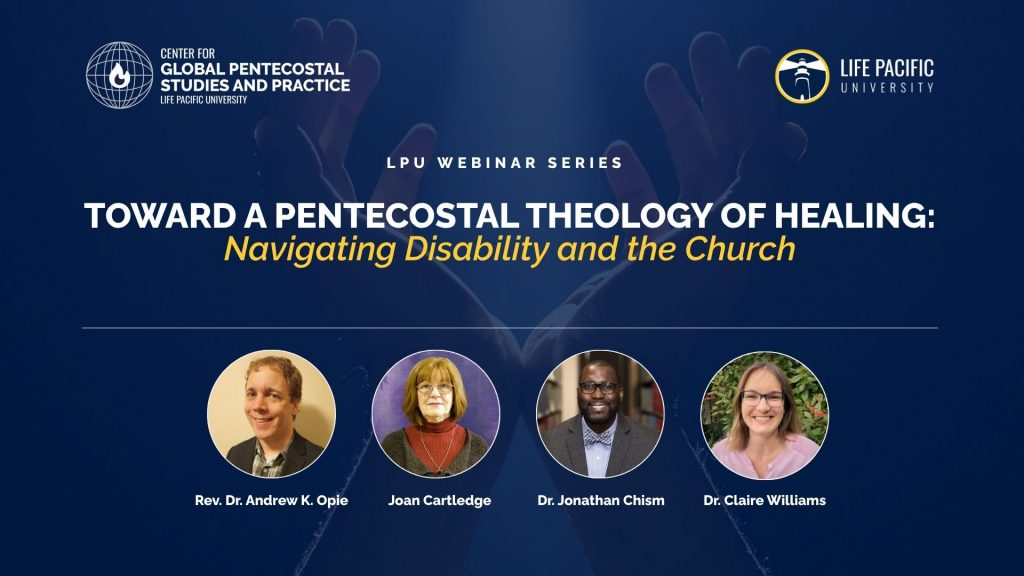
The Center for Global Pentecostal Studies and Practice hosted its spring webinar on Thursday, April 16 on Navigating Disability and the Church with panelists Dr. Andy Opie of LPU, Professor Joan Cartledge of London School of Theology, Dr. Jonathan Chism of The University of Houston-Downton, and Dr. Claire Williams of Regents Theological College (UK), and hosted by Dr. Bill Oliverio of LPU.
The panelists each brought experience and wisdom addressing this topic, whether through living life fruitfully with their own disability or those of family members, and in how they worked with others, including fellow church members, with disabilities. The discussion centered on the conviction that God loves and values persons with disabilities who image God to the church and the world.
Normalcy and Shalom
Dr. Opie opened by naming the two reductive frames which some Pentecostals have inherited, including those he has experienced himself, as a blind person. Some think that “if you’re disabled, it’s because you are a sinner. There’s something wrong with you,” he said. On the other hand, others suppose that “if you have a disability, you’re a saint.”
Dr. Opie pointed, instead, to the larger biblical category of shalom,” the Hebrew word for peace. “His punishment has brought us shalom, wholeness,” he said, referencing Isaiah 53. “It’s the phrase right before by His wounds we are healed.” True healing is entering into God’s peace, shalom, which means that healing is thus not a synonym for normalcy.
Dr. Opie pressed further, turning to portions of biblical texts that are often skipped over. “What about when God disables, such as when Jacob wrestled with and was blessed by God, yet he forever had a limp because of this disabling situation?”
What do We Pray for?
Professor Cartledge turned the conversation to findings from her research, drawing from her recent interviews that study people who live with disability and have been recipients of prayer ministry. Her findings indicated something notable for pastoral ministry.
“People make assumptions about what you’re coming for prayer for,” Prof. Cartledge said. “If you, for example, see Andy [referring to Dr. Opie] walking up to you, you assume he wants prayer for his sight, where in actual fact, maybe he wants prayer because he’s having a bad week.”
She described respondents who reframed disability as a feature of identity rather than a defect to be repaired. “I have a condition from birth. I don’t see it as a disability. I see it as a part of who I am,” one respondent told her. This theme reoccurred in her research.
“People who live with disability quite often are targeted. We must pray for healing [for them],” Prof. Cartledge said. “I actually find that, in my experience of talking to people who live with disability, they’re actually better healers in many ways [rather] than the people who need to be healed, because they understand what it’s like to live in that reality.”
Curing and Healing
Dr. Chism offered a historical example. Drawing on his research into William Seymour, who led the Azusa Street Revival that was central to the founding of modern Pentecostalism, he noted that this important historical figure in Christian history was blind in one eye, which occurred after he had contracted smallpox. Dr. Chism explained that Seymour felt that his sickness was a consequence of sin, a result of not accepting God’s divine calling.
Dr. Chism asked, “Why didn’t God cure Seymour, a holiness, spirit-filled pillar of Pentecostalism, of his monocular blindness?”
Leaning on theologian Kathy Black, Chism proposed a sturdier vocabulary, distinguishing curing, which he said, “removes symptoms,” from healing, which he described as the restoration of wholeness. He closed by sketching what a renewed Pentecostal theology might emphasize “Disabled bodies are not problems to be solved,” he said. “They are tabernacles where God’s power is revealed.”
Including and Belonging
“Testifying is a really key component of our faith. And because it’s so central, it becomes a boundary marker, a way of showing you’re in,” Dr. Williams said. “That’s problematic and difficult if you’re someone who doesn’t regularly communicate via speech, which is a factor in some autistic people’s lives.”
As an estimated 25-30% of autistic people are non-verbal, this question is far from theoretical.
Reading the biblical text of the woman who reaches for Jesus’ cloak in Luke 8 as a wordless act of faith, Williams suggested that the church can recover a wider grammar of belief that does not require speech to be valid. She closed with a passage from theologian John Swinton that lingered with the audience: “When you include someone, they get to join in,” Williams said. “But when a person belongs, you know they belong because they are missed when they are not there.”
Attendees Chime in and the Pace of Discipleship
The question and answer time moved into the relationship between a theology of healing and a theology of suffering, as Dr. Oliverio relayed questions posed by those attending through the Zoom webinar’s question and answer feature. The attendees posed interesting questions on other topics like the doctrine of divine impassibility (does God “suffer”?) and the pastoral care of nonverbal believers in church life in baptism and discipleship.
Dr. Opie troubled the very category of discipleship itself, asking whether a culture of efficiency has crowded out the slower work of being present with one another. Pointing to theologian Kosuke Koyama’s Three Mile an Hour God, he asked everyone to consider the pace of formation. “Are we willing to walk at the pace of people, and what if they walk a little bit slower?” and “What if they don’t walk?”
Drawing on philosopher Eva Kittay’s reflections on her daughter, he added a counterintuitive claim. “True independence is impoverishment,” Dr. Opie said. “If I do everything by myself, I have no friends. I have no one in my life. And ultimately, I’m impoverished.”
Closing Reflections
The panelists’ closing reflections converged on a single conviction: disabled persons are a gift to the church and the world.
“Don’t look at someone and what they can’t do. Think about what they can do,” Professor Cartledge said. “Healing is about experiencing God’s presence and power within able or disabled bodies,” Chism added.