Life Pacific University’s Counseling and Psychology team brings together mental health professionals and ministry leaders to explore loneliness, technology, and the importance of genuine human connection.
We live in a world where we’re more connected than ever. Messages arrive around the clock, social media keeps us updated on friends and family, and technology makes it possible to communicate with almost anyone, anywhere.
Yet despite all that interaction, many people still feel alone.
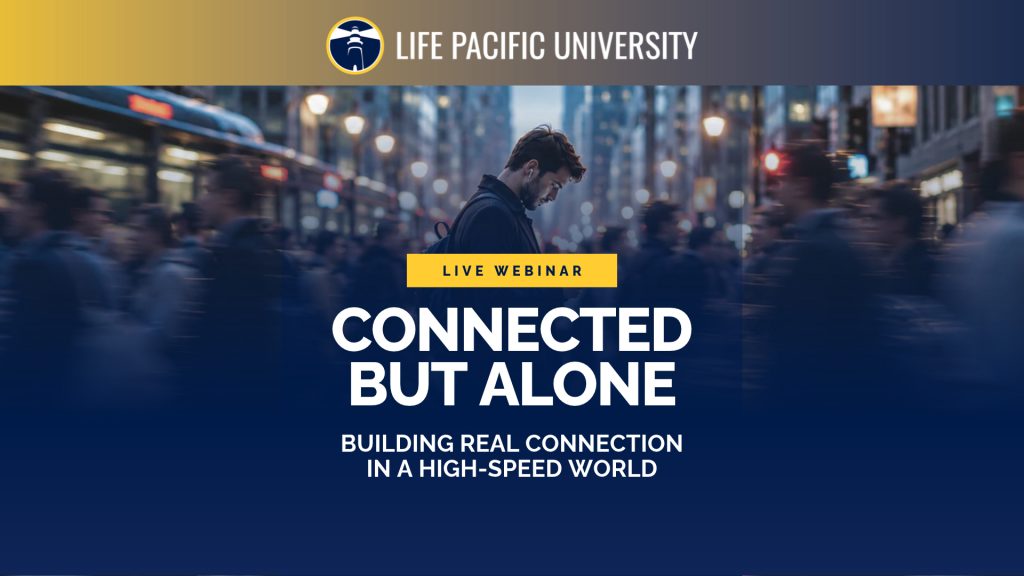
On October 29, Life Pacific University hosted Connected But Alone: Building Real Connection in a High-Speed World, a free webinar exploring why meaningful relationships can be difficult to maintain and what individuals, families, and leaders can do to strengthen them.
Led by Dawn Houk, Chair of Counseling and Psychology at LPU, the discussion brought together counseling professionals, an LPU alumnus, and a ministry leader to examine connection through four dimensions of well-being: emotional, mental, spiritual, and physical.
“Being reachable is not the same as being known,” Houk shared during her opening remarks.
Citing research from the World Health Organization, Houk noted that approximately one in six people worldwide experiences loneliness. She challenged participants to think beyond assumptions about technology and consider whether the people around them feel genuinely seen, heard, and supported.
Rather than simply encouraging someone to join another group or participate in another activity, Houk suggested asking a different question: “What kind of connection are you missing?”
The Importance of Being Present
Dr. Carole Gilmore, Chair of LPU’s Online Undergraduate Psychology Program and Field Director for the Master of Arts in Counseling program, explored the emotional side of connection and the importance of listening without immediately trying to solve someone’s problems.
Drawing from the biblical account of Hagar and the name El Roi, meaning “God who sees me,” Gilmore encouraged participants to recognize the power of making others feel seen.
“Our instinct when someone is struggling is to jump in with solutions or reassurance, but often this can prevent a person from truly feeling heard,” Gilmore explained.
She encouraged participants to become comfortable with silence, acknowledge another person’s emotions, and ask what kind of support would be most helpful before offering advice.
“Your presence and willingness to be uncomfortable alongside them is more powerful than any advice you could ever offer.”
Understanding Our Relationship With Technology
Maxwell Goodell, an LPU alumnus and graduate of the university’s Master of Arts in Counseling program, addressed the mental and behavioral patterns that influence how people engage with technology.
He explained how seemingly harmless habits, such as checking a phone for a quick message and spending another 20 minutes scrolling, can become automatic behaviors.
But he cautioned against treating all screen time as unhealthy or labeling someone as addicted simply because they spend significant time online.
Instead, he encouraged participants to consider what needs they’re attempting to meet through technology, whether that’s comfort, belonging, entertainment, or relief from stress.
The more important questions, he suggested, are whether digital habits are becoming difficult to control, interfering with responsibilities, or replacing meaningful experiences and relationships.
“The goal in all of this … is not digital perfection,” he explained, emphasizing the importance of greater awareness and the ability to make intentional choices.
Being Known Beyond What We Do
Steve Sewell, speaker, author, grief counselor, and founder of Encouraging Hope, explored the spiritual dimension of connection, particularly for pastors, ministry leaders, and others whose roles center on serving people.
Sewell challenged participants to consider an important question: “Who knows you when you have nothing to offer?”
He described how leaders can become so focused on helping others, fulfilling responsibilities, and maintaining their public roles that they neglect their own need for relationships.
“Sometimes, especially in ministry, we can become so busy doing things for Jesus that we simply neglect being with Jesus,” Sewell shared.
He encouraged participants to build relationships with trusted friends, peers, and professional mentors who can offer honest feedback, encouragement, and support.
Sewell also addressed the growing presence of artificial intelligence and other technologies in everyday life.
“AI can increase our capacity, but it can’t increase our humanity,” he said.
Small Changes That Build Stronger Connections
Closing the webinar, Houk returned to the physical dimension of connection, emphasizing that meaningful relationships don’t necessarily require major lifestyle changes.
Sharing a meal with a colleague, taking a walk with a friend, setting boundaries around after-hours communication, or simply putting a phone away during family time can create opportunities for connection.
She also encouraged leaders to evaluate whether their churches, workplaces, and organizations are creating environments where people can build relationships without feeling pressured to perform or accomplish a task.
Technology itself, she reminded participants, doesn’t have to be the obstacle. Online games, video calls, and group chats can strengthen relationships when used intentionally.
Rather than leaving participants with a long list of responsibilities, Houk offered a simple challenge: choose one small change that could help strengthen a relationship in the coming week.
The conversation also reflected the approach to education within LPU’s Counseling and Psychology programs, where psychological research, clinical practice, and Christian faith come together to prepare graduates to support individuals, families, churches, and communities.
Through webinars like Connected But Alone, LPU continues to share these perspectives beyond the classroom, providing practical resources for people navigating the challenges of modern life.
And perhaps the most important takeaway is also the simplest: meaningful connection begins when we make time to truly see and listen to one another.
Learn more about Life Pacific University’s Master of Arts in Counseling program.